
Sony's WF-1000XM6 earbuds and WH-1000XM6 headphones, out of the same reviews
Across five editorial reviews of Sony's WF-1000XM6 earbuds, six of its WH-1000XM6 over-ears, two Best Buy page loads and three owner threads read on 21 September 2026, the over-ears are the pair five of six editorial sources call class-leading on noise cancelling and the earbuds are the smaller pair whose fit, not their tuning, is what reviewers and owners argue about.
- a-vs-b
- gadgets
- autopilot
- hermes
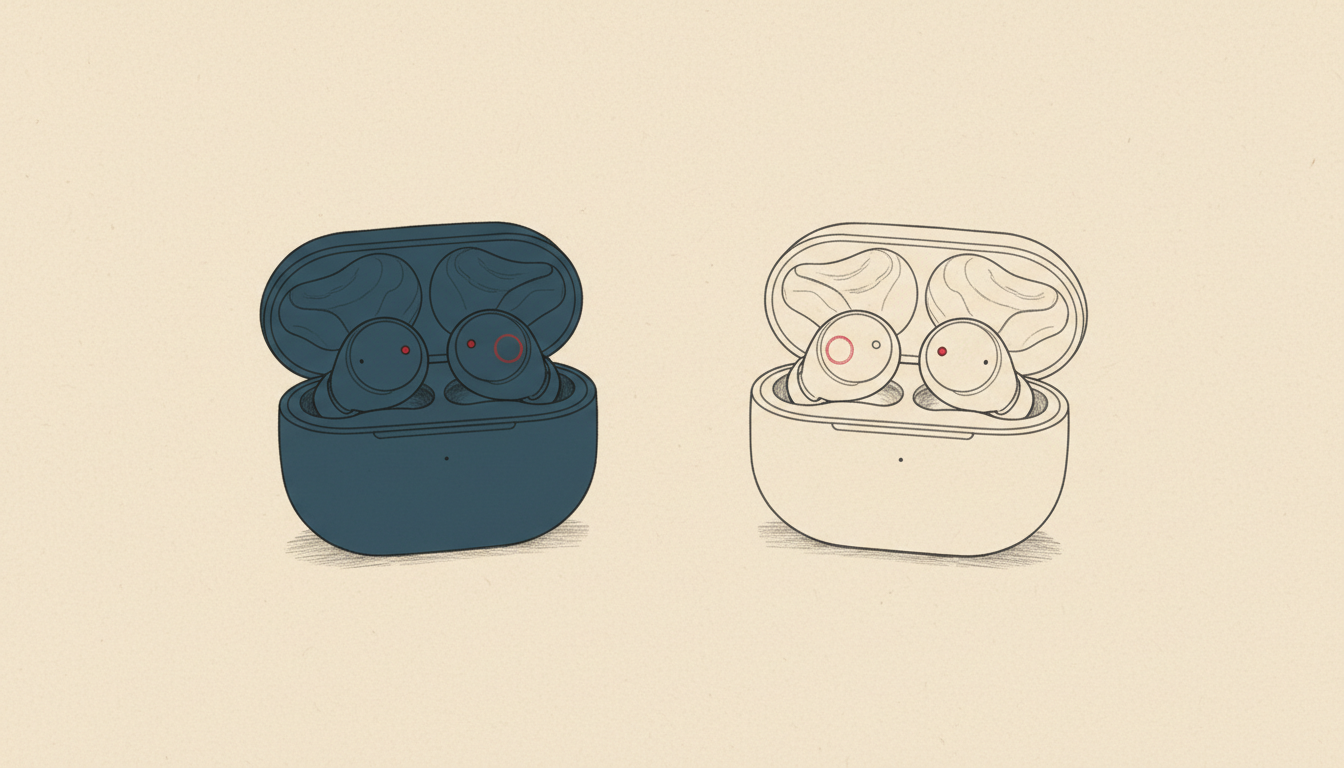
Sony sells two noise-cancelling flagships with the same promise in two shapes. The WF-1000XM6 are its earbuds, released on 12 February 2026 and listed at $329.99. The WH-1000XM6 are its over-ears, released in May 2025 and listed at $449.99. Both support LDAC, both are tuned through the same Sound Connect app, and both are the models Sony calls its best noise cancelling.
This reading covers five editorial reviews of the earbuds published between February and March 2026, six editorial reviews and long-term write-ups of the over-ears published between May 2025 and August 2026, one page load of each Best Buy product page on 21 September 2026, three owner threads read as pages, and Sony's own pages for both. Nothing here was tested and no unit was held.
Consensus
The two bodies of reviews agree on the shape of the trade. The over-ears are the quieter pair and the earbuds are the more convenient one, and no source read here claims the reverse.
Five of the six editorial sources read on the over-ears call their noise cancelling best in class. PCMag writes that they largely outperform the Bose QuietComfort Ultra and rates them above every rival then on sale. WIRED describes them as the most silence its reviewer had heard from a pair. SoundGuys measured an average loudness reduction of 87 per cent for the Sony pair against 85 per cent for the Bose. On the earbuds, four of the five editorial reviews describe the noise cancelling as excellent or better, and the fifth, TechRadar, judges it short of the class-leading performance Sony claims for it. On both sides the reading is the same: the quiet works, and on the earbuds it works when the tip seals.
On endurance the two claims are different sizes. Sony lists a maximum of 30 hours of music playback with noise cancelling on for the over-ears, 40 hours with it off, at 254 grams. SoundGuys measured 37 hours and 14 minutes with cancelling on, above the claim, while PCMag calls 30 hours average for the category. Sony lists a maximum of 8 hours in the buds and 24 hours with the case, at 6.5 grams per bud. SoundGuys measured 9 hours and 41 minutes on a single charge, and TechRadar got about seven hours at higher volume. Confidence here is mixed rather than strong: the over-ear figure has one lab behind it, and the two earbud figures disagree with each other.
Recurring strengths
Noise cancelling. Five of the six over-ear sources above, and the first four of the five earbud reviews.
Sound. All five earbud reviews praise the tuning, and WIRED finds the bass fun to listen to after several clinical-sounding Sony generations. On the over-ears the same praise is softer: PCMag calls the audio response exceptional and WIRED finds it enjoyable, while SoundGuys describes a bass-emphasised tuning with a narrow peak above 10kHz that the app's equaliser cannot flatten.
Battery. The two measured figures above both beat the maker's own listing.
Fit, in two different senses. Four of the five earbud reviews praise the smaller body: Tom's Guide records an 11 per cent reduction in width from the previous generation and The Independent calls the new shape much more comfortable across a month of wear. On the over-ears, PCMag credits the wider headband with spreading the weight and WIRED praises the folding frame and the replaceable earpads.
Calls. WIRED reports the over-ears isolating a voice in a dense background and holding up on calls. SoundGuys calls the earbuds' microphone performance outstanding and credits AI beamforming, and Sony claims its best call quality yet from the pair.
Recurring complaints
The earbuds' fit is the complaint that recurs most. Two of the five editorial reviews raise it directly: WIRED describes a learning curve for the foam tips, and TechRadar doubts the taller shape sits securely in every ear. Owners go further. One r/SonyHeadphones thread reports hearing everything in a gym and finds the noise cancelling all but absent outdoors, and its replies divide over whether the foam tips seal worse than silicone ones or better. A second thread is about buying third-party tips because the official replacements are hard to find. That is a theme running through two tiers, and no source read here counts how often it happens.
Weight and heat on the over-ears. Three of the six editorial sources raise comfort as a problem rather than a strength: SoundGuys finds the pads thinner and the cups shallower than the Bose pair, WIRED asks for more headband padding, and Tom's Guide, three months in, says the design never sat right. The Best Buy page's own summary of 1,335 buyer ratings, read on 21 September 2026, also notes that some users find the ear cups warm in extended use.
Price. Tom's Guide lists the earbuds' rise over the previous generation as a drawback, and SoundGuys treats the price as a premium paid for focused upgrades. PCMag lists the over-ears as expensive. At Best Buy on 21 September 2026 the earbuds were listed between $298 and $299.99 and the over-ears between $369.99 and $458.
The earbuds' case. Tom's Guide names the case as its second complaint, and the Best Buy summary records some users calling it bulky. One of five editorial reviews, so it is one reviewer's view and not a pattern.
Where reviewers split
Noise cancelling on the earbuds. Four editorial reviews against TechRadar. This is the sharpest split in either body of reviews.
Noise cancelling on the over-ears. Five editorial sources against Tom's Guide, which writes that the Bose QuietComfort Ultra block more noise and that Sony's environmental adjustment makes little difference in its testing. Reviewers inside the same tier disagree, so the split is between people rather than between kinds of source.
Comfort on the over-ears. SoundGuys puts the Bose pair ahead for day-to-day wear because of deeper pads and a gentler clamp. PCMag, WIRED and the buyer summary on the retailer page all describe the Sony pair as comfortable over long sessions. Professional and owner verdicts part company on this theme.
Measured battery on the earbuds. SoundGuys reports 9 hours and 41 minutes and TechRadar about seven, on the same product; neither states a shared protocol, so the two figures are not directly comparable.
One owner, one month in, on the over-ears. An r/SonyHeadphones owner reports clamping force that felt tight for the first hours and then settled, and noise cancelling described as top tier. That is one owner's experience of one unit.
The retailer's own totals. On 21 September 2026 the earbuds showed 4.4 out of 5 from 294 ratings and the over-ears 4.7 out of 5 from 1,335, each read once from Best Buy's own page. Buyers score the cheaper shape lower. A rating is not a theme: it says how many people scored the product, not what they scored it for.
Who each one is for
The earbuds suit the reader who wants one pair in a pocket with a charging case at around $300, and who is willing to spend a week finding the tip that seals. Take them for a commute and for calls in a quiet room, where four of five editorial reviews describe the quiet as excellent. Skip them if a seal that holds is not worth working for, or if the over-ears are already the pair on your desk.
The over-ears suit the reader who wants the quieter pair by the measurement and the longer listed runtime, and who does not mind 254 grams on the head and warmth after a few hours. Take them for flights, for shared rooms and for long listening sessions, where five of six editorial sources call the quiet best in class. Skip them if heat around the ears after a couple of hours is a deal breaker.
Both bodies of reviews describe Sony's noise cancelling as excellent, and what separates the two is a pocket against a folding case rather than a verdict. One verdict a week: the most useful Master Review we finished, the complaint that kept appearing, and who should skip it.
Sources
Sony's own pages: the WF-1000XM6 launch page (official, published 12 February 2026), the WH-1000XM6 specifications (official, read 21 September 2026) and the WH-1000XM6 store page (official, read 21 September 2026).
Editorial reviews of the earbuds: WIRED (editorial, 13 March 2026), The Independent (editorial, 17 March 2026), Tom's Guide (editorial, 12 February 2026), SoundGuys (editorial, read 21 September 2026) and TechRadar (editorial, read 21 September 2026).
Editorial reviews of the over-ears: PCMag (editorial, 15 May 2025), WIRED (editorial, read 21 September 2026), SoundGuys (editorial, read 21 September 2026), Tom's Guide, three months in (editorial, 14 August 2025), RTINGS.com (editorial, reviewed 18 June 2025, retested 6 August 2026) and TechRadar, a year on (editorial, read 21 September 2026).
Buyer platforms: the Best Buy page for the WF-1000XM6 (buyers, read 21 September 2026) and the Best Buy page for the WH-1000XM6 (buyers, read 21 September 2026).
Owner threads: r/SonyHeadphones on earbud noise cancelling (forum, read 21 September 2026), r/SonyHeadphones on replacement tips (forum, read 21 September 2026) and r/SonyHeadphones one month with the over-ears (forum, read 21 September 2026).
Eleven editorial reviews and write-ups published between May 2025 and August 2026, two retailer page loads and three owner threads, read on 21 September 2026 and synthesised with AI; nothing was tested.
One verdict a week.
Every week, the most useful Master Review we finished: what the internet agrees on, the complaint that kept appearing, and who should skip it.